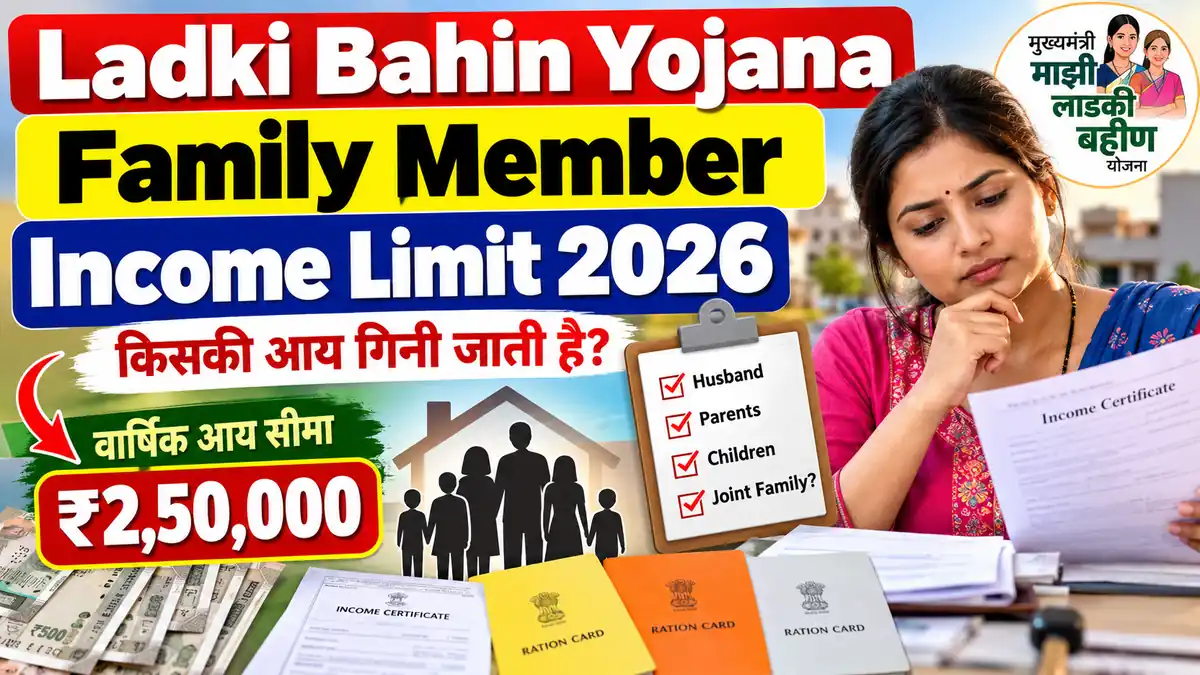
Women applying for the Mukhyamantri Majhi Ladki Bahin Yojana often have one important question: Whose income is counted when checking the family income limit? Some women earn very little themselves, but their husband or another family member earns money. Others live in a joint family and are unsure whether everyone’s income must be included.
Under the published scheme eligibility criteria, the applicant’s family must have an annual income of not more than ₹2.50 lakh. However, understanding the applicable family-income rules and submitting the correct documents are equally important.
If you want to understand the other eligibility conditions, you can also read our guide on Ladki Bahin Yojana Eligibility.
What Is the Family Income Limit for Ladki Bahin Yojana in 2026?
According to the Maharashtra Government’s published scheme guidelines, the annual income limit is ₹2,50,000.
Here is a quick overview:
| Particular | Details |
|---|---|
| Scheme name | Mukhyamantri Majhi Ladki Bahin Yojana |
| Annual family income limit | ₹2,50,000 |
| Monthly equivalent | Approximately ₹20,833 |
| Financial assistance | ₹1,500 per month for eligible beneficiaries |
| Income limit applies to | The applicant’s family |
| Income proof | Depends on the applicant’s ration card and applicable requirements |
The monthly equivalent is only a mathematical calculation of the annual limit. It does not mean that the government assesses eligibility using a separate monthly income threshold.
The scheme’s published criteria also include other conditions relating to residence, age, bank account details and exclusions. Meeting the income limit alone does not guarantee approval.
Whose Income Is Counted in Ladki Bahin Yojana?
The scheme refers to the annual income of the beneficiary’s family. Therefore, applicants should not assume that only the woman’s personal income matters.
For example, consider these situations:
1. A married woman who does not earn
Suppose a woman is a homemaker and does not have a job. Her husband earns ₹3 lakh annually. She should not assume that she qualifies simply because her own income is zero. The family-income condition needs to be assessed under the applicable rules.
2. A woman whose family income is ₹2 lakh annually
If the relevant family income is ₹2 lakh per year, it is below the ₹2.50 lakh limit. She must still satisfy the other eligibility requirements and provide the necessary documents.
3. A woman living in a joint family
In a joint family, applicants may be confused about whether the income of every relative must be included. The exact treatment depends on the applicable scheme rules and the family details used during verification. Do not automatically assume that every relative living in the same house is treated identically.
4. A woman whose husband and other family members earn
The relevant family-income assessment should be made using the official criteria and the information required for the application. Applicants should provide accurate details rather than excluding income based on assumptions.
Is an Income Certificate Required?
The document requirement depends on the applicant’s ration card category.
According to the Maharashtra Government’s published document guidance:
- Yellow ration card: An income certificate is not required under the stated document rules.
- Orange ration card: An income certificate is not required under the stated document rules.
- White ration card: An income certificate showing annual income within the prescribed limit is required.
- No ration card: An income certificate showing annual income within the prescribed limit is required.
Newly married women whose names have not yet been added to the ration card may have an alternative document option under the published guidance, subject to the specified conditions.
For a more detailed document checklist, read our article on Ladki Bahin Yojana Documents List.
What If Family Income Is More Than ₹2.50 Lakh?
If the applicable annual family income exceeds ₹2.50 lakh, the applicant does not meet the published family-income criterion.
Applicants should not submit incorrect income details or rely on an unofficial method to bypass verification. If an income certificate contains an error, they should contact the issuing authority to understand the correction process.
The scheme also has separate exclusion conditions. For example, the published eligibility information identifies income-tax-paying family members and certain regular government employees or pensioners among the exclusions. These conditions should be checked separately rather than treating the income limit as the only eligibility test.
How to Check the Latest Official Rules
Before submitting documents or making decisions about eligibility, applicants should verify the latest information published by the Maharashtra Government. Rules, document requirements and verification procedures may be updated.
Use the following checklist:
- Confirm the annual family income under the applicable criteria.
- Check whether an income certificate is required for your ration card category.
- Ensure the details in your application and supporting documents are accurate.
- Review the other eligibility conditions and exclusions.
- If your family situation is unusual, seek clarification from the appropriate scheme office before submitting the application.
Remember that an income below ₹2.50 lakh does not automatically guarantee approval. The application must satisfy all applicable conditions.
Frequently Asked Questions (FAQs)
The published scheme criteria set the annual family income limit at ₹2.50 lakh. Applicants should check the latest official rules before applying.
Applicants should not assume that only their personal income matters. The scheme uses family annual income, and the applicable rules should be checked for the applicant’s circumstances.
No. Under the published document guidance, women with yellow or orange ration cards do not need an income certificate. Women with white ration cards or no ration card need the prescribed income proof.
If the applicable family income exceeds ₹2.50 lakh, the family-income condition is not satisfied. The applicant should verify the relevant family-income assessment before applying.
No. The applicant must also satisfy the other eligibility conditions and provide the required documents. The final decision depends on verification under the applicable scheme rules.